Defined the three roles and what each one sees
Patient, clinician and administrator as separate permission sets over the same participant record, so the review view and the entry view cannot drift apart.
Case study · AIIMS New Delhi · 2026
SAM4GDM is a self-assessment and management application for pregnant women with a diabetic history — a group that needs close glycaemic surveillance right through pregnancy. It was specified as a research instrument first and a patient app second: every reading it collects has to survive analysis.
Self-reported data degrades quietly.
Managing gestational diabetes depends on readings a patient takes at home, several times a day, for months. Between appointments the clinician sees none of it. What arrives at the next visit is a paper diary — transcribed late, sometimes reconstructed from memory, and with no way to tell a reading that was taken from one that was remembered.
For care, that means an out-of-range value can sit unseen for weeks. For research, it means a dataset with gaps that look like normal values. Neither is solved by collecting readings faster; both are solved by knowing, per reading, when it was taken, whether it fell inside the permitted range, and whether anyone has looked at it.
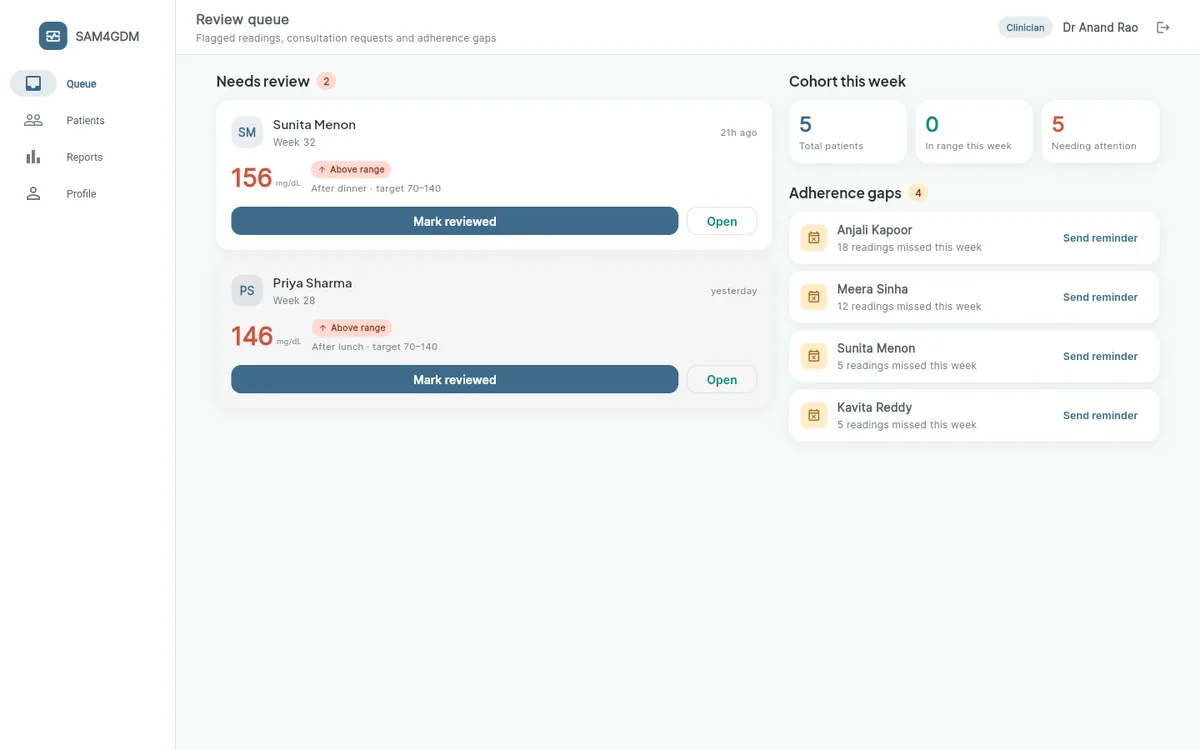
The design rule throughout: a gap in the data is itself a finding. Missed entries surface to the clinician rather than silently degrading the dataset.
Requirements and the clinical data specification for an in-house prototype, then acceptance of what was built against them.
Patient, clinician and administrator as separate permission sets over the same participant record, so the review view and the entry view cannot drift apart.
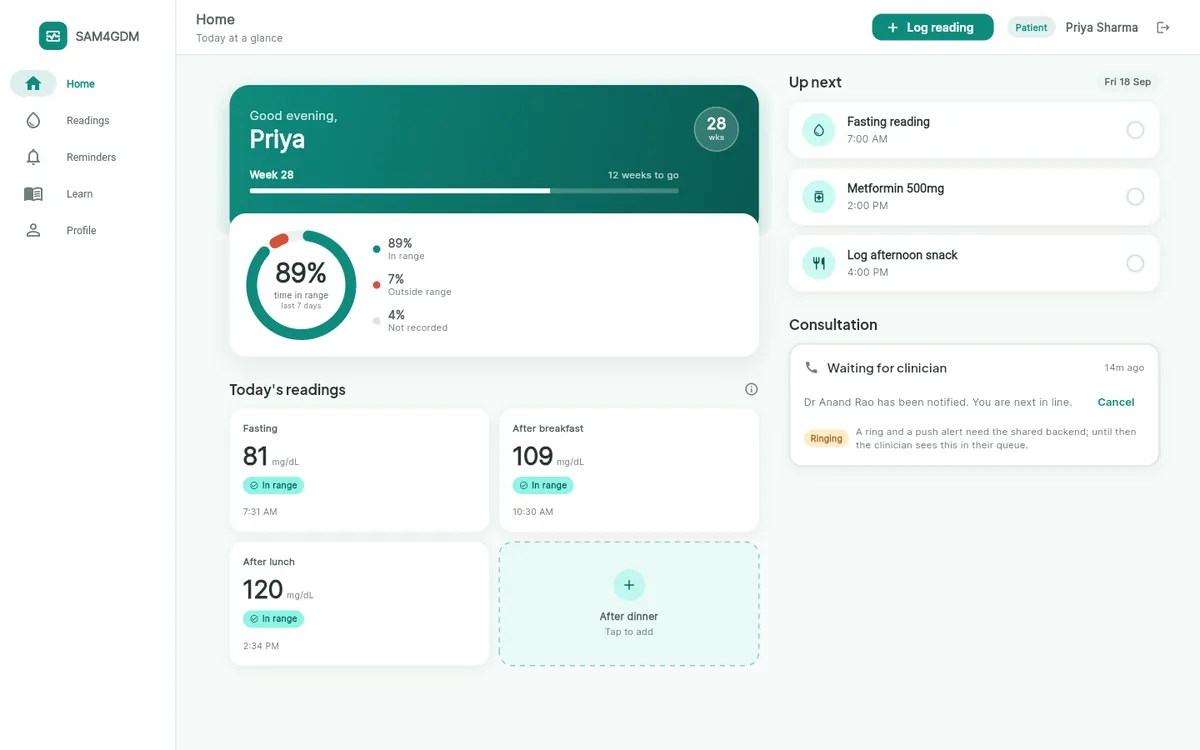
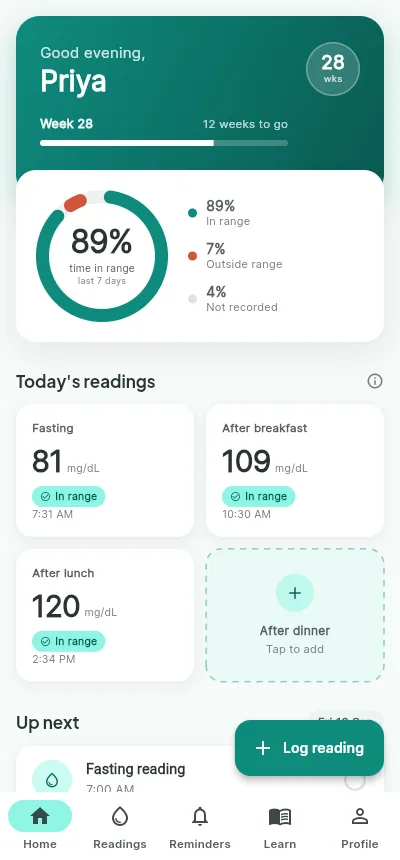
Value, timestamp, meal context and participant linkage, with permissible-range checks and automatic flagging of out-of-range readings for clinician review.
Prompts for dietary adherence, medication and insulin doses, and for entry of readings — so that what is not entered becomes visible rather than absent.
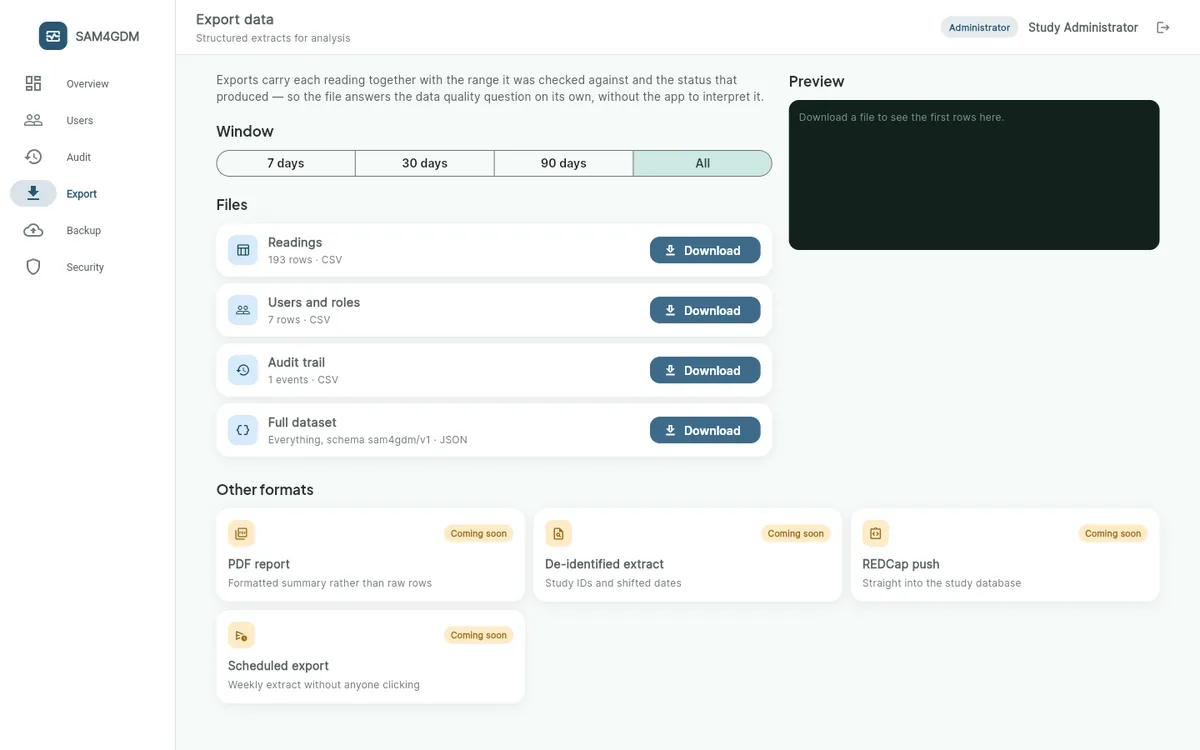
Audit trails, activity logs, user and security management, backup, and structured export for analysis.
The smallest unit in the system, and the one everything else is built on.
Scoped across the three roles. Everything below exists in the demo; what is still waiting on a shared server is marked "coming soon" inside it.
Glucometer entry with range checking at the point of entry, a week of readings as one ring, and reminders for readings, diet, medication and insulin.
Dietary guidance and educational content managed centrally, so what a participant reads is a known version.
Flagged readings and adherence gaps raised for attention; each participant's week, notes and prescriptions in one view.
Audio or video consultation requested by the patient, with a queue, one call at a time per clinician, and an unanswered state after 30 minutes.
User and security management with role separation, so clinical data is reachable only by the role that needs it.
Every export is itself an audit entry. Readings, users and the audit log export as CSV; a full snapshot as JSON.
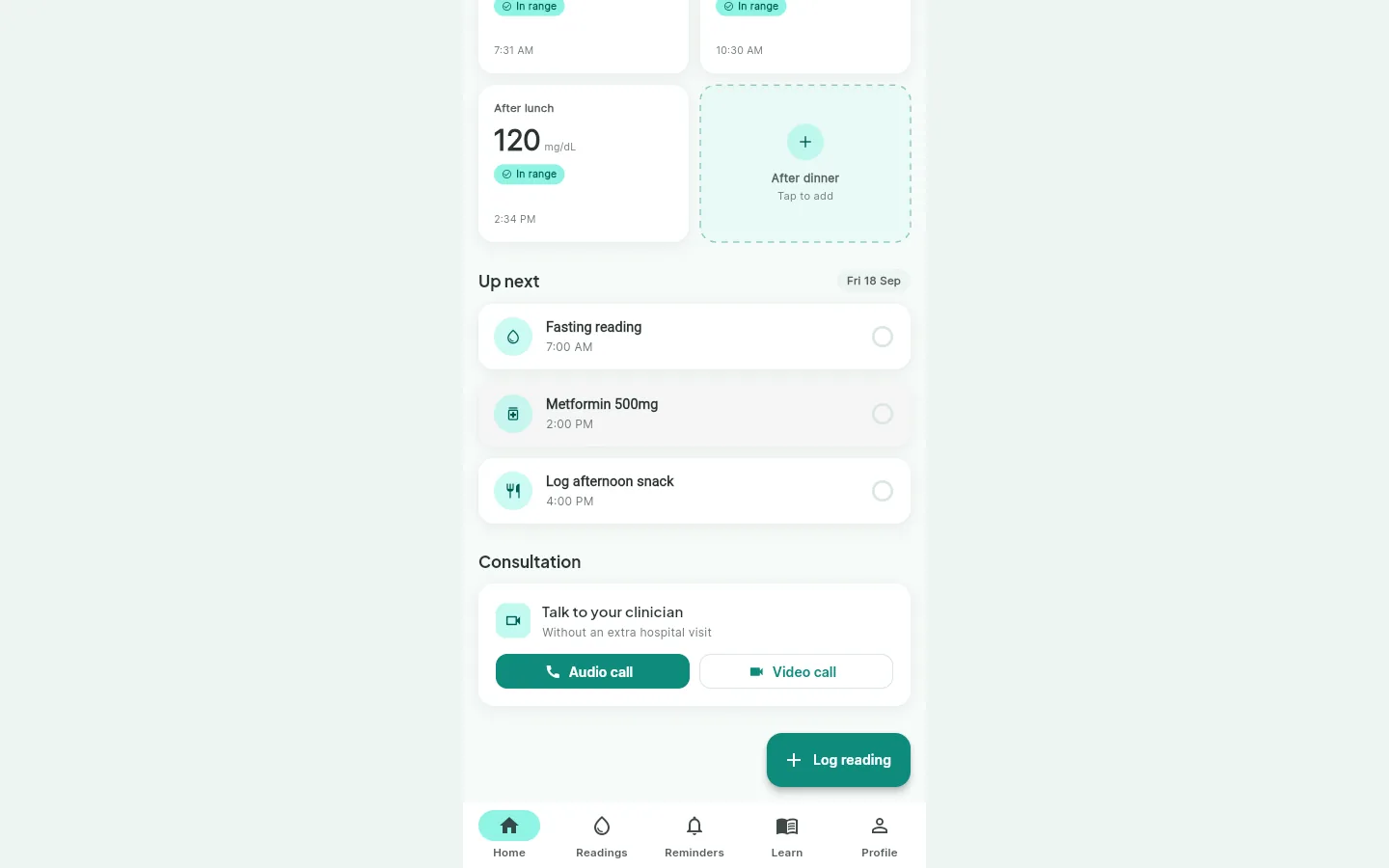
SAM4GDM is a prototype. The requirements, data model, validation rules and governance modules are specified and built out as a working demonstration on seeded data. It has not been deployed clinically and holds no real patient data.
About the demo. Choose a role on the first screen. Data is generated and kept on your own device; nothing is sent anywhere.